Learn

Robotics & Automation

Empower Your Business with Cloud Innovation

Learn how machines sense, think, and move. This topic explores how mechanical components, sensors, and control systems come together to build autonomous robots and automated processes.

Motion & Actuation

Understanding motors, servos, and drive systems that turn electrical energy into coordinated movement. Students learn torque, gearing, and how to design reliable mechanical motion.

Motion & Actuation

Understanding motors, servos, and drive systems that turn electrical energy into coordinated movement. Students learn torque, gearing, and how to design reliable mechanical motion.

Motion & Actuation

Understanding motors, servos, and drive systems that turn electrical energy into coordinated movement. Students learn torque, gearing, and how to design reliable mechanical motion.

Sensors & Feedback Loops

Cameras, ultrasonic sensors, encoders, IMUs — these allow robots to interpret their surroundings. This point focuses on how robots use feedback to adjust behavior in real time.

Sensors & Feedback Loops

Cameras, ultrasonic sensors, encoders, IMUs — these allow robots to interpret their surroundings. This point focuses on how robots use feedback to adjust behavior in real time.

Sensors & Feedback Loops

Cameras, ultrasonic sensors, encoders, IMUs — these allow robots to interpret their surroundings. This point focuses on how robots use feedback to adjust behavior in real time.

Control Algorithms

From PID loops to path-planning and basic AI behaviors, students learn how software decisions guide physical actions with precision and consistency.

Control Algorithms

From PID loops to path-planning and basic AI behaviors, students learn how software decisions guide physical actions with precision and consistency.

Control Algorithms

From PID loops to path-planning and basic AI behaviors, students learn how software decisions guide physical actions with precision and consistency.

Automation Systems

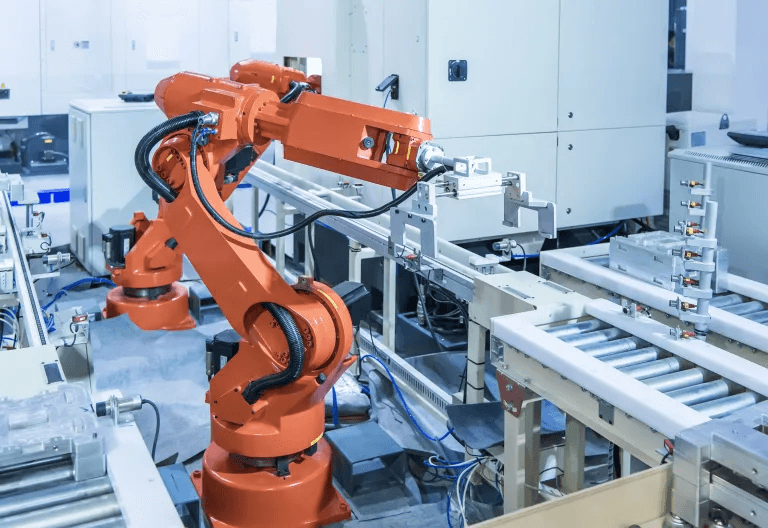
Explores how robots perform repetitive tasks autonomously — conveyor mechanisms, pick-and-place systems, and industrial-style workflow automation.

Automation Systems

Explores how robots perform repetitive tasks autonomously — conveyor mechanisms, pick-and-place systems, and industrial-style workflow automation.

Automation Systems

Explores how robots perform repetitive tasks autonomously — conveyor mechanisms, pick-and-place systems, and industrial-style workflow automation.

What is Robotics and Automation?

Robotics and automation is the discipline of designing machines that can move, sense the environment, and perform tasks without constant human control. It blends mechanics, electronics, and programming into one system. Whether it’s a two-motor educational robot or an industrial manipulator, robotics teaches logical thinking, spatial reasoning, and how to bring hardware and software together to solve real-world problems.
Company Carousel

🤖 Boston Dynamics
🏭 FANUC
🚗 Tesla (Manufacturing & Robotics)
📦 Amazon Robotics
♻️ ABB Robotics
🏙️ NVIDIA (Robotics AI)
🦾 KUKA Robotics

How we use Robotics:

Students apply robotics and automation skills by designing robots, programming behaviors, and testing how machines respond to different conditions. You learn to iterate: adjust hardware, tune software, measure results, and improve the system. These skills translate directly into fields like manufacturing, autonomous vehicles, warehouse automation, and research robotics.

Unlock the Potential of Scalable Solutions for Success.

We help you to elevate your projects!

Unlock the Potential of Scalable Solutions for Success.

We help you to elevate your projects!

Unlock the Potential of Scalable Solutions for Success.

We help you to elevate your projects!